
Community, Culture, and Leadership in Public Health Scholarship
By Public Health Communications • Updated December 2025
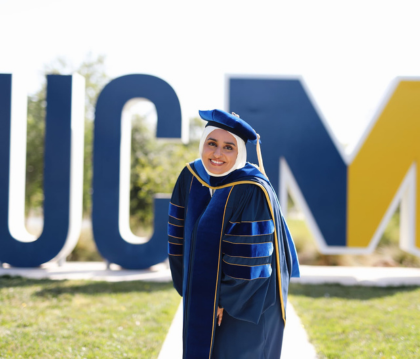
Sarah Alnahari, a recent graduate of the UC Merced Public Health doctoral program, brings a deeply personal and community-informed lens to public health research. Her lived experiences—such as living in Merced, being from Yemen, and her first-generation immigrant experience—informs how she understands health through the stories, resilience, and agency embedded within communities.
Dr. Sarah Alnahari
Dr. Alnahari interest in public health was sparked by hearing a presentation by Dr. Valerie Yerger (UCSF) on how the tobacco industry targeted African American communities through menthol cigarettes. These findings resonated deeply with her, particularly given her upbringing in the Middle East, where smoking is widespread. To gain the research tools necessary to support communities both in the United States and abroad and to challenge the structural forces shaping tobacco use, Dr. Alnahari applied to PhD programs, and UC Merced stood out as a place where this kind of justice-oriented work was encouraged.
At UC Merced, Dr Alnahari’s research focused on tobacco use in Middle Eastern and North African (MENA) communities, looking beyond individual behavior to examine broader structural and cultural contexts of tobacco use. Her research shows that strong ethnic identity may serve as a protective factor against smoking and examines the social and cultural forces that sustain tobacco use across generations. Her research has been recognized through several honors, including the Tobacco-Related Disease Research Program Predoctoral Fellowship and the Graduate Dean’s Dissertation Fellowship. She was also a finalist in UC Merced’s Grad Slam competition.
While a student at UC Merced, Dr. Alnahari co-founded the Public Health Graduate Student Group, mentored first-year graduate students through GradEXCEL, and served as the Public Health Delegate to the Graduate Student Association.
Dr. Alnahari plans to pursue a research or academic position to expand her work on tobacco use, structural determinants of health, and MENA-related health equity. Future goals include developing culturally grounded educational materials and research translation tools shaped by community priorities, as well as advocating for improved inclusion of MENA populations in public health datasets.
Her advice to future public health students is:
"When faced with roadblocks, pivot. Curiosity, community, and trust in one’s lived experience, she emphasizes, are powerful drivers of impactful public health work."
Learn more about our student leaders: Visit the Student Leaders Page