
By Public Health Communications • Updated May 2026
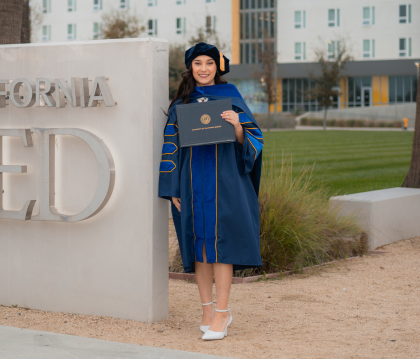
Valerie Martinez, PhD, 2025, is a lifelong resident of California’s San Joaquin Valley and a first-generation college graduate rooted in Merced County. Raised in Livingston, she earned a BA in Psychology, MS in Public Health, and PhD in Public Health from UC Merced. Her upbringing and training shape her commitment to public health, environmental justice, and research that gives back to the communities that raised her.
Her path to public health and epidemiology began early. Born preterm with intrauterine growth restriction, Valerie developed an interest in perinatal health and pregnancy-related challenges. Living in a region affected by high rates of low birthweight, health disparities, and severe air pollution motivated her to address adverse pregnancy outcomes through an environmental health lens. Family influences and research helped her move from psychology to public health and pursue doctoral training in perinatal and environmental epidemiology under Prof. Sandie Ha, her PhD advisor, dissertation chair, and leading environmental health researcher and epidemiologist.
Valerie studied how the place and exposure negatively affect pregnancy health. Her master’s project examined whether contact with certain environmental chemicals (cadmium, arsenic, hexachlorobenzene, oxychlordane) may be linked to infertility among reproductive-age women. Her dissertation examined connections among predominantly Latino neighborhoods, air pollution, prenatal care utilization, and birth outcomes, including full-term babies born with low birthweight. Her work underscores the need for equity-focused interventions so that every family has a health start.
Valerie has contributed to peer-reviewed publications and conference presentations, supported inclusive learning as a Teaching Assistant, and served as Vice President of the Public Health Graduate Student Group. She also worked as a graduate student researcher on the Fresno Health Impact Assessment in Assembly Bill 617 communities in South Central Fresno, combining analysis with community engagement to support policy-relevant solutions.
"You belong in these spaces, and your perspective is essential to meaningful public health work."
Looking ahead, Valerie plans to continue public health research in a public health agency or institution focused on population health and health equity, informing programs while bridging epidemiology with community priorities.
Her advice to future public health students, especially first-generation college students, is to trust lived experiences are strengths, not limitations. A path does not have to be linear to be meaningful. Seek mentors, ask questions, and stay connected to the communities inspire one’s work.
Learn more about our student leaders: Visit the Student Leaders Page